
Often, two terms become synonymous with each other, forming an inseparable pair. For example: Swiss and cheese, French and wine, Mercedes and star or couch and armchair. Volvo is also synonymous with a second term, which is an inseparable part of its brand: FH. These two letters are what anyone who works with trucks associates with Volvo. That's because FH has been the embodiment of modern vehicles for over two decades.
Complete truck range with the FM
The FM series, by contrast, stands somewhat in the shadow of the FH trucks. But this neglect is not deserved. That's because the FM and its derived construction site truck, the FMX, present a much larger and more variable product family than the FH. With the FM (and FMX), Volvo offers a complete range of trucks – from 18-ton vehicles and all-wheel dump trucks to four-axle tractors. The FH series only caters to long-distance travel, with some limits.
The FMs are also capable of this, of course. They are also less expensive, offer slightly better payload and – thanks to their modern engines – are perhaps even more efficient than the FH vehicles. On the downside, the amount of space on offer in the cab is somewhat smaller. Although the cab shares essentially the same design as that in the FH, it is fitted much deeper and the luxury that we know from the FH is very limited here. Although Volvo has modernized the FM series to meet Euro 6, this has not been as consistent as the modernization in the FH. Some features, such as the comfortable independent suspension, are not available at all in the FM.
One advantage of the FM is the small, compact six-cylinder D11K engine with 10.8 liters displacement, which you can't get in the FH for love nor money. Thanks to common rail injection and up to 2,400 bar of injection pressure, it is more modern than the D13K, which has two more liters of displacement and still injects fuel via a unit injector system. The D11K is also 200 kilograms lighter.
Small engine, big power
The vehicle we tested featured the most powerful configuration of the D11K (450 hp/332 kW). Those looking for more power can choose the larger D13K, which Volvo offers in three power classes (420, 460, 500 hp/309, 338, 368 kW) for the FM. The advantage of the larger engines is the slightly higher torque, with maximum torque available slightly earlier. Admittedly, the differences in torque are not that large. The smaller engine in the 450-hp configuration generates 200 Nm per liter of displacement, while the larger 460-hp engine achieves 180 Nm. Purchasers of the D11K have to do without several benefits of the FH, such as the high engine brake power (375 kW) of the VEB+ engine brake, which was developed for the unit injector engines and is not available for common rail.
That is why the D11K suffices with an engine brake power of 290 kW.
The trump card of the D11K is certainly the way it combines high power with low displacement. It generates such high power in the lower and middle speed range from a relatively large torque of 2,150 Nm at 1,000 to 1,400 rpm, drivers will rarely want a larger engine. 306 hp (225 kW) are available at 1,000 rpm, with the nominal power nearly reached at 1,400 rpm with 430 hp (316 kW). According to Volvo's own literature, the D11K works most efficiently between 1,100 and 1,350 rpm. Revs can vary, however, from 950 rpm to 1,500 rpm, without having a negative influence on the fuel efficiency of the D11K.
The I-Shift gearbox – in this case the AT2612E – also sticks pretty closely to these rules. In inclines, it shifts down at 1,100 or no less than 1,050 rpm, even though the D11K still has pulling power at these low revs. At the other end of the scale, the I-Shift normally does not go beyond 1,400 rpm. This results in a very good fuel consumption of 34.6 l/100 km, putting it among the best 40-ton vehicles and well below the average of all previously driven Euro 6 trucks. Currently, consumption in 40-ton Euro 6 tractors on the test route ranges from 34 to over 36 l/100 km. The only outlier below this range is the Scania G410 with 32.9 l/100 km. The gearbox is well spread, and unlike manual gearboxes manages without crawler gears. Gear ratios of 14.94 to 1.00 are pretty practical. There are also four reverse gears, the lowest of which is slow enough at 17.48 to 1 to make delicate maneuvering easy.
Space at a premium in the driver's cab
In the FM, it's clear that Volvo used other proven techniques to reduce consumption beyond just the engine and gearbox. The high axle ratio of 2.50 to 1, for example, which reduces the revs to around 1,150 rpm at 85 km/h, as well as the "anticipatory" cruise control with I-See function. This now works very well after a few initial teething problems. I-See now detects the topography better than before and can be adjusted more variably. It is now possible, for example, to drive 5 km/h below the set speed value, whereas previously it was just 3 km/h. Admittedly, the system does not work as perfectly as those from Scania or Mercedes yet. This is because I-See often takes its foot off the gas a little late, such as at the end of an incline, driving over the crest of the hill a little faster than necessary.
One typically Volvo feature is the slightly different exhaust gas purification system. At first glance, it appears to consist of all the usual components: exhaust gas recirculation (EGR), SCR and oxidizing catalytic converters, and a diesel particulate filter. Volvo,however, only uses the non-cooled EGR to increase the exhaust gas temperature at low load, making it similar to an SCR-only system. This has clear benefits in terms of diesel consumption, especially at full load. It does, however, lead to higher AdBlue consumption, which in the Volvo FM is at 7.4 percent (of diesel) or 2.5 l/100 km. Based on current fuel prices, this corresponds to around a liter of diesel. These costs can be more than halved by refueling from bulk fuel containers.
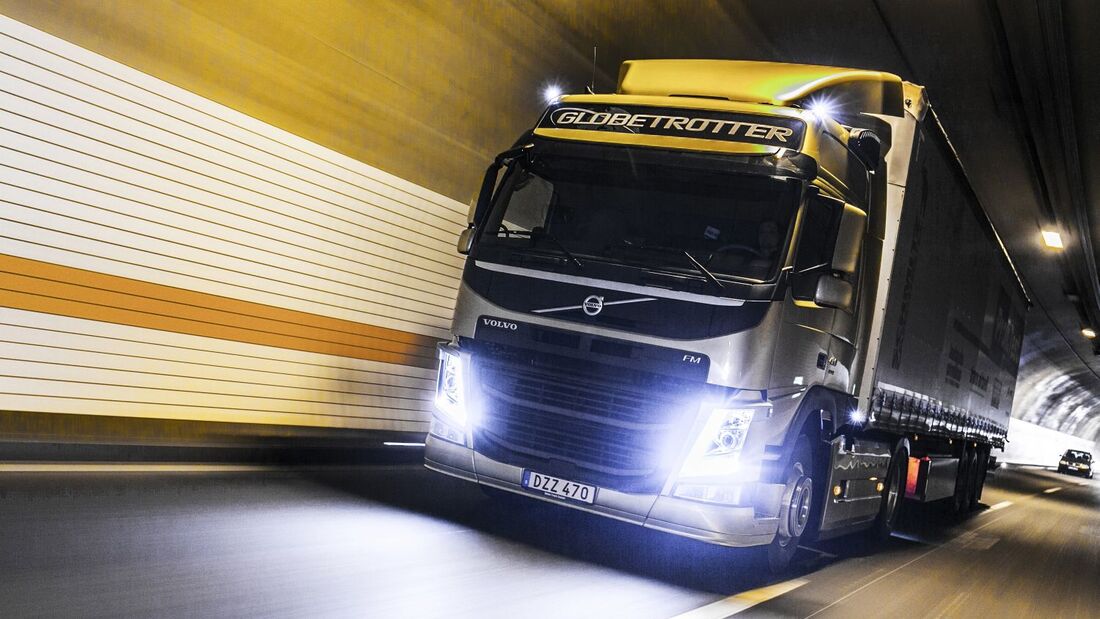
Anyone who buys a Volvo FM will usually have something else in mind than long-distance trips that often involve sleeping in the driver's cab. Although the FM is fully capable of long-distance travel (with one driver), it is best at regional and national transport. The deep-mounted driver's cab with extra low entry (1,245 millimeters) has the same length and width of that in the FH, but its engine tunnel extends almost half a meter into the driver's cab. Despite a generous internal height (2,054 millimeters), the LXL Globetrotter driver's cab does seem somewhat tight, especially when the nice and practical storage panel is fitted on the rear wall.
High driving comfort
Volvo uses two tricks to increase freedom of movement in the driver's cab. The panel above the windshield tapers in the middle, and the functions of the I-Shift gear lever, which is usually mounted on the right side of the driver's seat, can be moved to the dashboard. Although this gets the lever out of the way, the switches are hard to reach on the dashboard. The best spot for the I-Shift controls would certainly be to the right of the steering wheel, but there are already plenty of levers here. Storage space in the FM driver's cab can only be considered good if you order the rear-mounted storage panel. This increases total storage space to 560 liters, and would be over 200 liters lower without the rear panel. Another recommended optional extra is the raised lower bed, as this allows a refrigerator to be installed within reach of the driver. If the lower bed is installed, the refrigerator can only be fitted in a more difficult to reach spot above the driver in the rear storage space.
The driving comfort and performance of the FM give virtually no reasons for complaint. The only downside is that the single-leaf suspension on the front axle is not quite as responsive as the standard two-leaf suspension. It does, however, save 50 kilograms of unladen weight and helps make the FM suitable for payload-sensitive transport. Fully equipped, with full tanks (400 liters of diesel, 80 liters of AdBlue) and a spare wheel, it weighs around 7,200 kilograms. This is around 250 to 300 kilograms lighter than the FH.
Interior noise is lower than any other truck in this category, the result of effective insulation and the smooth engine running. Handling is foolproof thanks to both a new and extremely smooth steering system and the well-tuned cabin suspension with front coil springs and rear air springs. In conclusion, the Volvo FM 450 is a powerful but efficient truck, which combines high payload with good driving comfort and flawless driving performance. There is plenty of space for drivers working alone, with only the high engine tunnel posing a significant limit to freedom of movement.