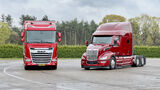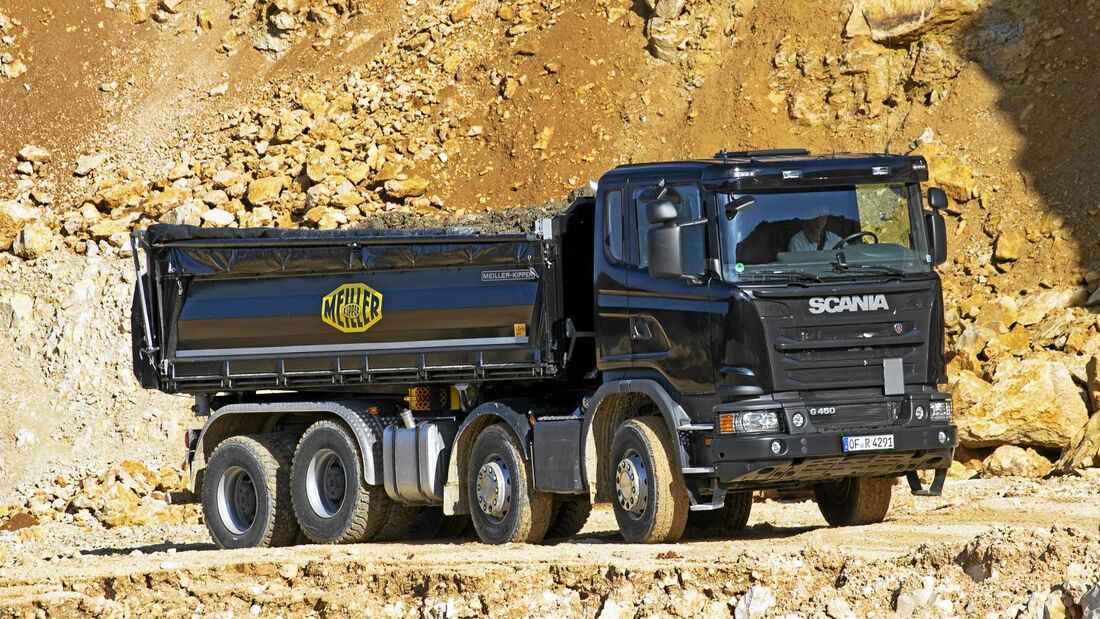

They both share the same name and look confusingly similar. But despite their identical model designation, they are fundamentally different characters. Say hello to the Scania modular system. The manufacturer gives customers the choice, even in the same performance class. The 450 HP engine that powers both candidates is available for Euro 6 with both EGR and SCR or in the SCR-only version.
Two big brothers, different details
The all-black model relies on the traditional recipe with both ingredients, whereas its counterpart with a white driver's cab uses SCR-only. The first difference is in the weight, with the SCR-only model weighing precisely 37 kg less. Although it requires more AdBlue, it will save one or two extra drops of fuel.
When it comes to the rest of the vehicle, the Scania modular system leaves customers spoiled for choice with a wide range of possible variants. Customers can pick and choose to their heart's content. One example is the short G cab with low roof. Even though the engine tunnel here rises nowhere near as high into the driver's cab as in the lower P cab, the total height of the vehicle (3,160 millimeters) is still low enough to avoid collisions even with old silo loading points 3.4 meters off the ground. This still leaves a significant climb to the driver's seat. The distance of 1,625 millimeters separating the cab floor from the ground is bridged by a total of four steps.
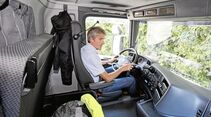
The cab offers around 4.9 cubic meters of enclosed space, with the engine tunnel measuring 290 millimeters in height. Two things dominate inside the Scania's cab. First the typically wide, curving cockpit. Second, the fold-out bed for an occasional siesta. Both features do not exactly help freedom of movement. The protruding cockpit makes itself particularly noticeable when there is just 1,800 millimeters between the windshield and the back of the driver's cab, as is the case in the short G cab. The shelf beneath the end of the cockpit juts out further into the interior, meaning that climbing through is no easier. The bed on the rear wall takes up yet more space whether folded up or down, making the cab feel even tighter. Although this interior architecture feels more Japanese than Swedish, it does come with a few benefits. There's a reason why drivers rate the classic Scania cockpit so highly, as virtually everything, including the rotary switch for the differential locks, is in the right place. By today's standards, however, especially compared to the minimalistic arrangement in the new Volvo FH, it does seem somewhat excessive.
On the road, the Scania dump trucks definitely go their own way. The Scania dump trucks have to this day shown no interest in the new streamlined components that aim to reduce fuel consumption in road vehicles even more. Instead, there is a sturdy external step and railing for visually checking the dump body. At the front, the Scania dump truck stands out from its long-distance counterparts with a split steel bumper, which extends 130 millimeters forward, making it useful for the building site. It also features a robust standing platform above it, as well as two front rings that can be used to clamber toward the windshield.
Special characteristics
If this area is dominated by uncompromising practicality, the chassis makes compromises of its very own. After all, the abbreviation "KO" doesn't just mean versatile dump body preparation in general, but also a very special, weight-saving frame. It features a mono design without the aid of a second loop, which turns the chassis into a little payload champion. The downside to this is that the frame requires a special kind of high-strength steel to give the chassis the necessary stiffness. Although this limits the torsion properties somewhat, its does a world of good in terms of payload.
But this all depends on the respective specification. There is a good half-ton difference in the unladen chassis weight between the two candidates. And when it comes to drive comfort, they are worlds apart. The black model, for example, is somewhat grating and rustic, and also struggles to claim to be fleet-footed when put on the weighing scales. The test shows that more than 10.2 tons of unladen weight remains for the chassis, once the just under 4.1 tons for the dump body and hydraulics are subtracted. This isn't exactly a bad weight, but it could be much better.
Two components alone, such as the use of drum brakes rather than disc brakes all around or three-leaf instead of two-leaf springs at the front axle, can make the vehicle 210 kilograms heavier than necessary. Add in the lightest construction tires you can get and few more weight-saving tricks here and there, and the G 450's chassis is already 350 kilograms lighter.
One model out in front
In bare numbers, this means the chassis weighs in at 9,850 kilograms with a full 300-liter aluminum tank. And if that weren't enough, another 82 kilograms can be saved with a vertical exhaust pipe instead of an exhaust mounted underneath. Calculate in another 107 kilograms for smaller fuel and AdBlue tanks (200/42 liters instead of 300/80 liters, respectively), and it becomes clear how light a KO chassis can be. At just 9.66 tons unladen weight, it comes in well below the ten-ton mark.
Best of all, however, making weight-reducing investments such as disc brakes and two-leaf springs is rewarded with extra driving comfort. The drum brakes in the black G 450 behave as if they were from a different age. Difficult to dose, they start too timidly and then suddenly turn vicious. By comparison, the disc brakes in the white G 450 are wonderfully dosable and always predictable. This clearly makes them the better choice, and more payload friendly to boot.
The differences in suspension are less striking. But the motto of "less is more" still applies to the front axles and cab suspension. This is because the two-leaf parabolic springs of the white, SCR-only dump truck harmonize far better with its coil-sprung cab than the three-leaf parabolic suspension and air-sprung cab do in the black G 450.
The two 13-liter siblings cede no ground to each other in terms of the performance curve, both going about their work with a power that is unique for this displacement class. In numbers, the pair generate precisely 2,350 Nm between 1,000 and 1,300 rpm. In comparison, many competitors struggle to match this, even those in a higher hp category. The 450-hp Scania engine easily handles a 32-ton four-axle vehicle, even at low revs.
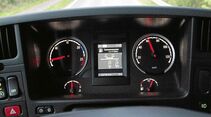
The interplay between the 4.05 rear axle and the GRSO905R overdrive gearbox is the perfect match here. The tachometer indicates 1,080 rpm at 65 km/h on a country road. This rises to around 1,420 rpm when going at 85 km/h on the freeway. Combined with the Active Prediction anticipatory cruise control, which is available for just 480 euro, the dump truck is the model of fuel-efficient driving. One new feature here from Scania: The EcoRoll function is now no longer solely active with the cruise control engaged, but is now set on the gas pedal, so to speak. This means that coasting goes its own way when the driver's foot is off the pedal and the topography is favorable.
Drivetrain impresses off road
The drivetrain also stands its ground off road. When things get steep and tricky, drivers should reach for the crawl levels at the other end of the gear scale, as taken care of by the off-road mode in Scania Opticruise. What's astonishing is the level of precision Scania has now granted to the off-road mode in the automatic gearbox.
The KO dump truck is therefore far more than just a gravel hauler. And besides, in this configuration it doesn't want to be a real off-road monster anyway. With payload reserves like this, we'll happily accept the odd compromise in the cabin. The drivetrain is outstanding for mixed use both on and off road.