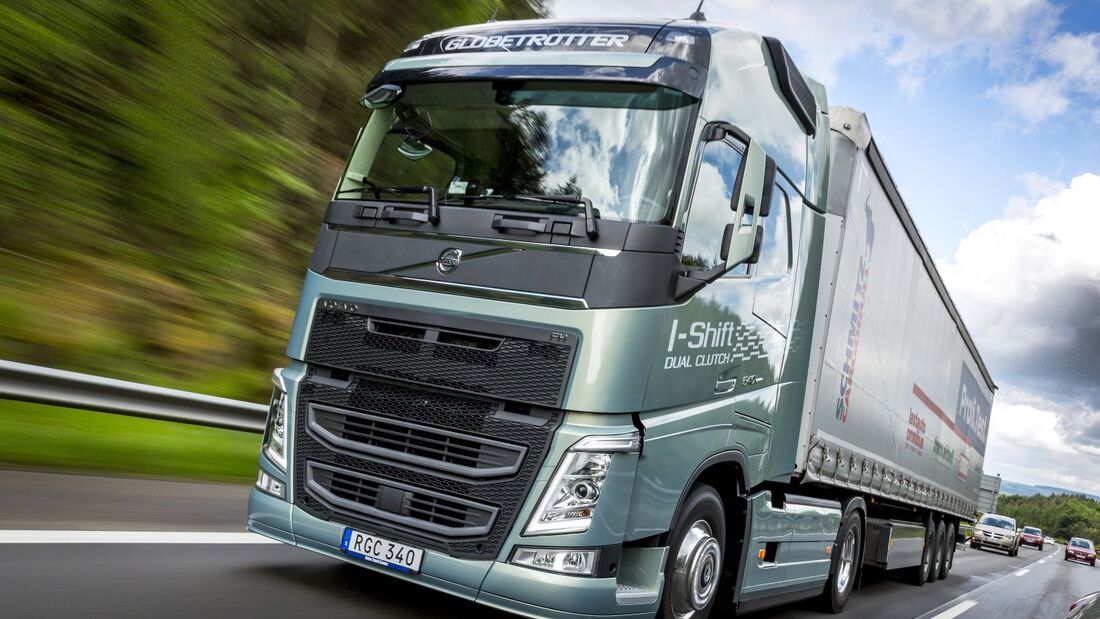
In general, truck engines are among the fastest running out there. Even if the definition of low-, medium- and high-speed engines is not 100% clear, the D13K in the Volvo FH540 leans towards the medium-speed engines. Low-speed engines usually work at three- or low four-figure revs, and are overwhelmingly used in medium-sized freight or passenger ships.
The reason why the 12.8-liter, six-cylinder engine in the most powerful variant is not far from being a ship engine is partly to do with the engine characteristics. It delivers plenty of power down to 900 rpm, with the maximum torque of 2,600 Nm available just slightly above this. If needed, all 540 horses can be galloping away at just 1,450 rpm. Future engines from Volvo and other manufacturers will work at even lower revs than this D13K. Among the factors that make this possible here are the extremely high axle ratios, which keep the cruising revs down while still allowing for plenty of power in reserve when driving in top gear. The FH 540 runs at just 1,100 rpm when traveling at 85 km/h.
Quick-shifting dual-clutch gearbox
On top of this, there's the new I-Shift Dual Clutch (DC) gearbox, which shifts through the gears so quickly that the rev intervals are much shorter when shifting on an incline. This means that drivers can shift down later and up earlier, which in turn keeps the engine revs down. In the Dual Clutch, however, this is not a gear shift in the classical sense. That's because two gears are in use (two pairs of gear wheels) long before the actual gearshift. In conventional gearboxes, this would kill the gearbox stone dead.
Compared to all other previous truck gearboxes, however, the DC variant of I-Shift works with two nested and therefore fully independent drive shafts, which are allocated to certain gearing pairs (gears). There is also one clutch per drive shaft. This is what makes it possible to have two gears engaged at once. Shifting occurs when one clutch opens and the other closes. This virtually eliminates traction interruptions. All gears can be shifted in this way, apart from the range group shift between sixth and seventh gear. Shifts across two gears are only possible in the conventional manner, i.e. with a short traction interruption.
Low revs
This combination of an engine that's very powerful at low revs, a high axle ratio and the dual-clutch function leads to revs that are so low that what was originally a high-speed engine generally becomes a medium-speed engine. Theoretically, this should also lead to improved consumption, were it not for two countering factors: a peculiar exhaust gas purification system and the overdrive configuration of the I-Shift gearbox.
The consumption of 35.3 l/100 km recorded on the test route is acceptable, even considering the drive performance. But the additional 3.2 l/100 km of AdBlue consumption is currently equivalent (in euro) to around an extra liter of diesel. Most heavy trucks manage 1.0 to 1.5 l/100 km if they fulfill Euro 6 in combination with an exhaust gas recirculation system (EGR). The Volvo engine also has an (uncooled) EGR system, but only uses it to keep the exhaust gas temperature as high as possible at low engine load to ensure that the SCR system and particulate filter work as effectively as possible. This rather strange Euro 6 solution is presumably the compromise that was necessary in order to achieve the Euro 6 exhaust gas values with the "old" unit injector injection system. This therefore raises the question of why Volvo continues to stick to the system in the knowledge that a common rail injection can do all this much better.
Consumption benefits wasted
One completely inexplicable element is the configuration of the Dual Clutch gearbox in the Overdrive design. After becoming the first manufacturer in the world to create such a great gearbox for heavy trucks, Volvo then throw away all the consumption benefits with the Overdrive. This can only have been the work of a bean counter, as Volvo is seen around the world as an expert when it comes to drivetrain development. Despite all the criticism of these things, however, it's not as if anyone could complain much about the actual consumption. The 35.3 l/100 km are pretty standard for this performance class, if not the top values that would be possible with common rail and direct-drive gearbox.
That's because in essence, the FH is perfectly suited for efficient long-distance driving. The good aerodynamics are confirmed (despite Overdrive) by the good partial load consumption values. Combined with the now well-functioning I-See system (the name Volvo gives to its anticipatory cruise control) and the almost perfect interplay of gearbox control, I-See and high-power retarder, this creates the perfect conditions for quick and efficient driving. The FH 540 masters even hill roads, forcing its way up every incline with low revs but a ton of power.
Furthermore, the FH is a great truck for drivers, even if the cockpit sometimes feels a little too compact. This is due to the compromise in interior length (up to ten centimeters), the imposing instrument panel angled toward the driver and the storage space in the rear. All this limits the freedom of movement somewhat, even in the largest Volvo cab (Globetrotter XL). Fortunately, it has no effect on the FH's economics, control (with small limitations) or driving enjoyment.
Slight weaknesses in control
One of the weaknesses in the controls is the small tachometer in the bottom part of the speedometer. Even if the arrangement looks nice, this is not exactly an advantage. The same applies to the I-Shift controller on the dashboard, an arrangement that is optionally available. Normally, the lever for the I-Shift is located to the right of the driver's seat. Neither location is really a good solution. The best solution would be a lever to the right on the steering column, although this area contains plenty of leavers already.
Handling, driving behavior and comfort are all impressive. A large part of this is due to the smooth but highly precise steering, known as "Dynamic Steering." The dual-clutch gearbox certainly went down well with the driver. The gears shift smoothly from one to the other without the driver feeling a thing. In many cases, the only indication of anything happening in the gearbox is the needle on the tachometer and a barely audible fall and rise in the engine noise. This outstanding and sophisticated DC gearbox comes at a hefty price of almost 5,000 euro. What's more, you don't necessarily need the new independent suspension with rack-and-pinion steering in order to feel good about the FH's comfort and driving performance. The improved standard front axles and a more rigid frame make it possible.
Overall, the FH 540 is a fantastic long-distance semi-trailer tractor for drivers and operators alike. Until a direct-drive variant of the I-shift DC is available, however, the standard automated gearbox is the more efficient solution for long-distance driving. The Swedes are reluctant to name a launch date for the long-awaited engines with common rail injection. The introduction was originally planned for three years ago. But even without common rail, the FH 540 is an extremely efficient and above all fast medium-speed truck.
Class reunion
The FH 540, the best representative of the FH series, went up in the single test against its sibling, the FH 16-750, which is currently Europe's strongest series-produced truck and was brought along by Thomas Tschakert, who is responsible for testing at Volvo in Munich. Driving both semi-trailer tractors across the hilly and partially mountainous test route showed that you don't necessarily need 750 hp to transport a load quickly. Even on this demanding topography, 540 hp are enough, especially as the FH 540 turned out to be pretty powerful. Although the FH 540 loses two or three minutes in total on the really hefty inclines, there were virtually no differences in speed on the other road sections. In terms of consumption, the FH 16 consumed up to five percent more diesel when the going was easy. Consumption levels barely differed when driving uphill, however. One measurement went badly wrong, however. The editors wanted to know how much speed was lost when shifting on inclines in both the I-Shift and I-Shift Dual Clutch. The Dual Clutch lost no speed. Admittedly, neither did the I-Shift in the FH 16, because on this road there was simply nothing to shift.