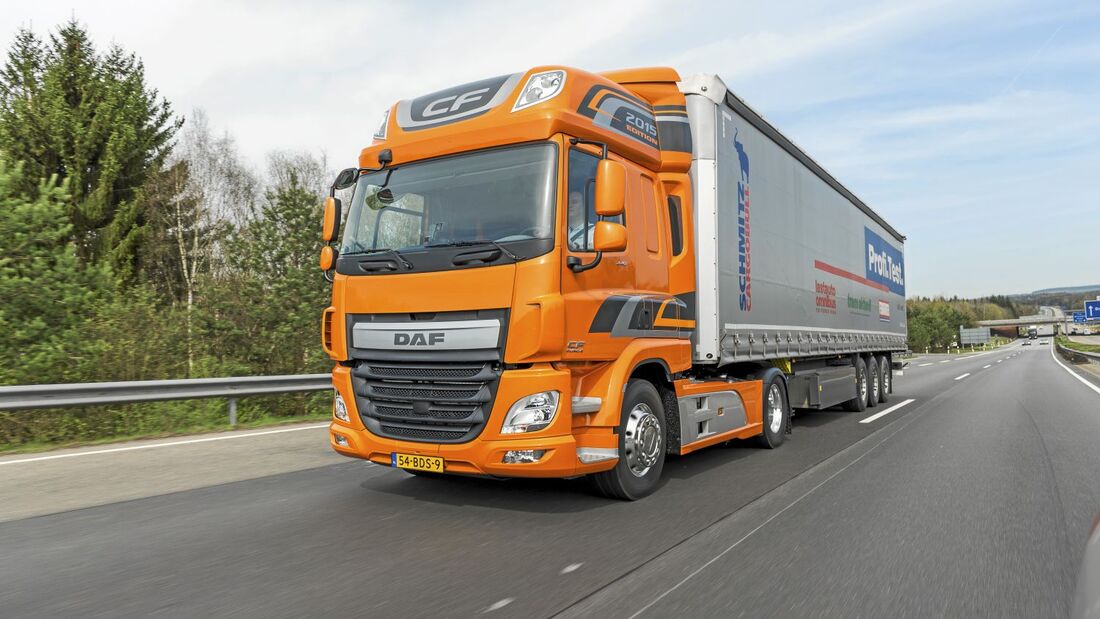

Introducing Euro 6, completely overhauling the model lines and reorganizing the product range—DAF has been pretty busy over the past two or three years. The Dutch company is now working on the details as part of its 2015 initiative. This slogan is also appears prominently on the current test vehicle, a CF 440 Space Cab. With axle configurations from 4x2 to 8x4, DAF`s versatile model for on-road and construction-site applications is available with a broad range of engines: twelve engine output ratings of 220 to 510 hp from 6.7 or 10.8 and 12.9 liters displacement. The most powerful version of the MX-11 10.8-liter unit is designated the 440` which stands for 435 hp and 2,100 Nm torque.
According to DAF, Edition 2015 or the DAF Transport Efficiency program includes consumption-optimized MX engines (MX-11 and MX-13), improved aerodynamics with new roof and side spoilers, and Predictive Cruise Control (PCC) with Eco mode and influence on the shifting strategy. Referring to the MX-11, the Dutch speak of optimized oil management and more efficient combustion through modifications to the combustion chamber, fuel injection and software. DAF estimates that the new generation consumes up to two percent less fuel.
In the final assessment, the CF 440 actually does perform well in terms of diesel consumption. With Euro 6 in the EGR plus SCR variant, the combined fuel consumption of 33.9 liters represents a new record on the test circuit. So far, just Iveco and Scania have matched or fallen below this value with their SCR-only engines. However, their engines consume considerably more AdBlue. It therefore remains to be seen which of these two approaches will prevail in the near future.
Low average speed
The low diesel consumption is paired with an average speed of 80.4 km/h, which is rather modest in this power class. There are several reasons for this. One of them is the rear-axle ratio of 2.53 to 1, resulting in only 1,160 rpm in twelfth gear at a highway speed of 85 km/h—it´s hardly possible to climb hills without shifting. Another factor is the Eco mode, a new standard function of all CF and XF variants. This mode reduces the torque by ten percent in the first eleven gears, decreasing day-to-day diesel consumption by around one percent according to DAF. If full power is needed briefly, the driver can push a button at the end of the steering-column stalk in automatic mode to deactivate Eco mode for 30 seconds. Eco mode switches off automatically when the truck encounters an incline, but the option of driving is manual mode still remains.
When setting the cruise control, the undershoot can be set in three speed-dependent steps. Values of -10, -7 and -4 km/h are available at the usual test speed of 85 km/h, with the factory driver recommending the medium value for the test circuit. In corresponding situations, the display indicates that the PCC will be activated and will use the undershoot ahead of an approaching downhill stretch. The freely adjustable brake cruise control performs the overshoot function. This is simple and logical, just like control of the PCC functions overall. Another positive trait: as in the Mercedes Actros, the cruise control permits precision adjustment in steps of 0.5 km/h. However, despite the fairly powerful MX engine brake (435 hp at 2,100 rpm), the brake cruise control frequently requires the driver to apply the disc brakes. DAF dispensed with a retarder in the interest of realizing the lightest possible test vehicle (only around 7.2 tons in the specification). Stepping on the brakes deactivates the cruise control (but the brake cruise control remains active, of course). It´s important to keep this in mind at the end of downhill stretches. A sensible innovation: the MX engine brake is now adjustable in three steps; it was previously "all or nothing. When driving downhill, it is generally advisable to downshift to tenth gear earlier than the automatic system would (around 2,000 rpm at 90 km/h).
Does this save fuel? Yes. Is it annoying? You bet.
The system will accelerate ahead of inclines only if it determines a positive effect on fuel consumption. This was the case only once over the entire test circuit. On inclines, the AS-Tronic shifts half gears at around 1,000 rpm. No gear steps can be perceived, but one gets the impression that tenth gear would be the better choice on some long mountain routes–another reason being to avoid losing too much speed.
The advance terrain detection function is most obvious during the frequent Eco-roll phases at idle. Whereas the gearbox remains in gear when the truck crests a hill in overrun mode, it shifts up and down when the terrain is only slightly hilly. On road sections of this type, the vehicle alternately coasts at idle to around 82 km/h and then accelerates to 85 km/h again. This might save fuel, but it can also get on one´s nerves in the long run. By the way, measuring the interior noise in the usual place is a trying experience, because the vehicle hardly ever responds uniformly to throttle inputs.
Exactly 1,000 mm available
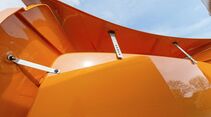
The new roof spoiler adjustable in five steps is ten centimeters higher than before (there is no helpful crank as with the XF); the new side spoilers are slightly longer. The parts can´t be folded in, making climbing up at the rear somewhat of a chore. There also isn´t a curved pipe; with the dummy plugs on the driver´s cab rear wall, DAF did little more than what was absolutely necessary for the trailer connections. A small 45-liter AdBlue tank is mounted behind the rear wall on the driver´s side, freeing up more space on the frame. With the diesel tank on left, exactly 1,000 mm is available on the right with a wheel base of 3.60 meters. The air tank and batteries are accommodated in the rear—a new option with the Euro 6 generation. By contrast, an electric cab tilting mechanism still isn´t available. Apart from this luxury problem, the main drawback is the small storage compartment on the driver´s side (especially considering that there is none on the passenger´s side)
Almost unchanged
The CF has largely adopted the interior from its big brother, the XF, and the internal height of its Space Cab even exceeds that of the XF bearing the same name. However, it is not as wide (2.3 instead of 2.5 meters) and the bulky engine tunnel is more than 40 centimeters high. On the other hand, easy entry to a cab floor height of 1,230 millimeters is provided via only two steps. The bulky front structure in the center console unfortunately lacks the practical and sturdy pull-out table, which is a popular feature in the XF. Unlike in the new XF edition, the side windows in the CF are still split and the storage compartments in the doors cannot accommodate large bottles. On the positive side, there is a generous half a cubic meter of storage space in total under the window and under the bunk bed. The cockpit is also well designed overall, and even new DAF drivers will quickly become familiar with the controls.
Engine
Inline six-cylinder engine (Paccar MX-11) with variable turbocharging and intercooler, one-piece cylinder head, dual overhead camshafts, four valves per cylinder. Wet, replaceable cylinder liners, Euro 6 with SCR, EGR and particulate filter
Chassis
U-profile ladder frame (260 x 75 x 6 mm), spread at front, with bolted and riveted cross-members; two-leaf parabolic suspension at front, four-bellows air suspension at rear; TRW hydraulic power steering, ratio 19.0 to 1; 450 mm steering-wheel diameter; electronically controlled and ventilated disc brakes all around; 430-liter aluminum diesel tank, 45-liter AdBlue tank on left fender; batteries in rear overhang.
Driver´s cab
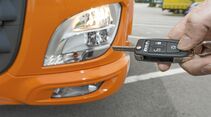
DAF CF Space Cab; all-steel driver´s cab with high roof, jeopardized metal panels galvanized; four-point air suspension; two bunk beds; electrically adjustable and heated main and wide-angle mirrors; central locking system with remote control and feedback function by exterior lights; LED headlights with washer system; skylights (two headlights integrated into driver´s cab roof); roof and side spoilers, equipped with telescopic window cleaner set as standard.
Assessment
Positive : Comfortable ride and suspension, smoothly running engine with plenty of power at low revs, simple and logical operation, low unladen weight, favorable consumption, easy entry via two steps, large interior in this vehicle class
Negative : Displays difficult to read under incident sunlight, no curved pipe for trailer connections, no electrohydraulic cab tilting mechanism available, only one small exterior storage compartment with narrow opening, narrow storage compartments in the doors, split side windows, front lid not locked from the inside.