Daimler´s premium Setra brand generally cultivates an exclusive and priceless image—and not just recently. The more the better seems to be the motto here. And the Ulm-based company is becoming more and more comfortable in its benchmark position in areas like electrical equipment and cockpit design. This may work and could be intentional in the coach segment, at least in its luxury sector. After all, the numbers agree with this long-established brand. On the other hand, despite good profit margins in the luxury sector, there is also a lot of money to be made with the right product at the other end of the market. This is especially true for the area of inexpensive, no-frills dual-income sources. This is the playing field shared by the Mercedes sister brand with its Intouro, which is largely identical to the Multi-Class, as well as by other manufacturers like Iveco and Temsa or, recently, MAN with the Lion’s Intercity it just introduced.
Smart customer loyalty and profit maximization strategy
What at first glance seems to be the last hurrah of the old 400 model line actually turns out to be a smart customer loyalty and profit maximization strategy. This model family, launched in 2006, now includes more than twelve members in finely graduated lengths from 10.50 to 15 meters and with various body configurations. Formulated in terms somewhat unfamiliar for this brand, the stated aim is to guarantee highly economical use of the with efficient and economical equipment items. Or to put it briefly: less is more.
Realizing such a comprehensive claim is naturally very difficult with the ultra-modern but expensive 500-series platform. Setra is therefore the only model line to continue using the previous 400-series platform that dominated the image of the German bus market in the 2000s. Technology nerds may regret this decision, but there is hardly an alternative for the cost cutters. After all, the design of the proven Setra model line is far from being antiquated—the subdued but enduring Setra Longlife design pays off here.
Entry-level price below 200,000 euro
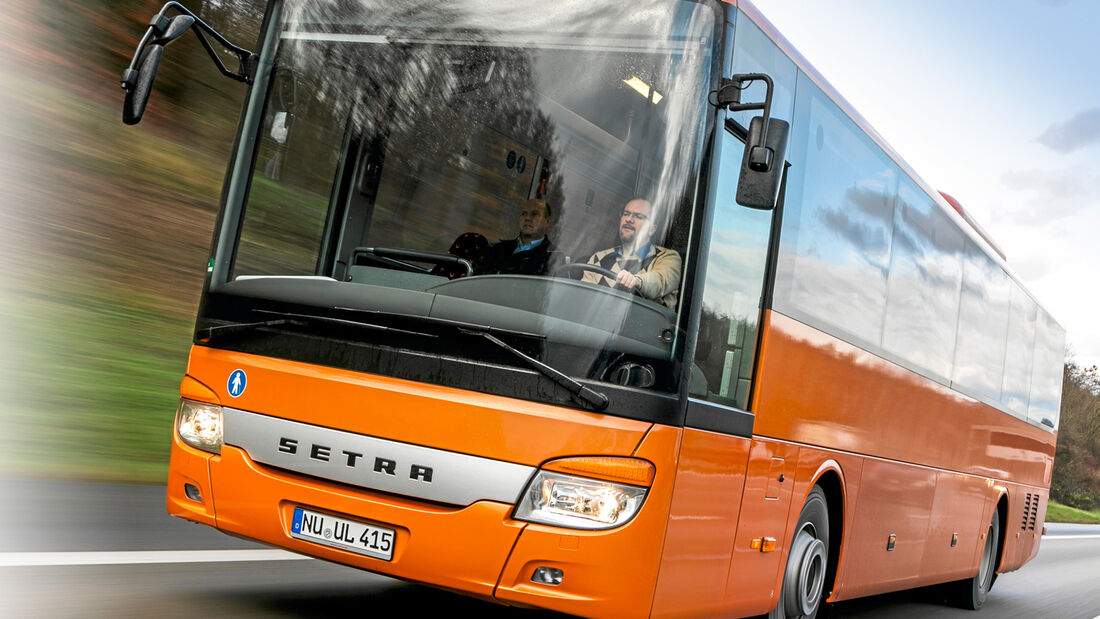
Of course, realizing an entry-level price below 200,000 euro (which, incidentally, differs little from the Mercedes counterpart) required the product strategists to put a lot of effort into "downgrading" the bus as much as possible. This already begins with the peppy orange bodyshell. This Turkish-made workhorse dispenses with much ornamentation, like the brand badge on the b-pillar or the painted appliqués on the doors reaching all the way up into the roof. Only the steep windshield and the more robust mirrors on metal tubes are standard. The fit and finish are good per se, but a few details like the coarse bolt heads in the interior and the finger-wide gap under the cockpit, which is visible from the outside through the driver´s window, do offend the eye.
Entry to the interior is gained through doors reaching almost all the way into the roof, making them ideal for tall people too. There is no tour-guide seat blocking the front passageway. There is no toilet or refrigerator either. The cockpit comes from the intercity model line, which doesn´t impair its familiar ease of operation in the slightest.
A lot of plastic is combined with adequate storage space; a multifunction steering wheel is also lacking in this class. We are nevertheless immediately comfortable behind the wheel; everything is where it belongs. The mirrors, with their slightly martial appearance, can also be said to provide quite good visibility, even though they shake slightly.
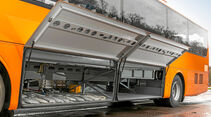
The door is available in widths of 900 and 1,380 millimeters, with the latter being the prerequisite for a wheelchair lift. This naturally requires a place for the wheelchair opposite the door, with four simple folding seats next to it. This variant does, however, shrink the ample and very well-organized 5.2-cubic-meter luggage hold to 4.9 cubic meters.
Interior is more functional
The interior itself conveys more of a functional than a cozy feel, and even the standard Transit seats can´t fundamentally change this impression. Transparent plastic storage compartments, which are often useful in fast-paced intercity transport, are available at extra charge. On the other hand, a convector heater is unavailable at any price. This is due to the somewhat odd podium design in the vehicle, which the Setra shares with the Mercedes Intouro. Lowering the floor by around 16 centimeters to a height of 877 millimeters compared to the high-decker vehicle eliminates a step leading to the center aisle and increases the standing height accordingly, but this also results in an ugly, somewhat obstructing platform of the same height above the front axle and extending over two to three seat rows. This topography near the floor means that four 3.5-kW fan-type heaters are used instead of convectors along the entire length. Should the best places in the bus be specially marked?
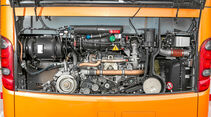
The driver´s seat at the front left is not a bad place to be. Not least, this is thanks to the vehicle´s solid driving performance. The design of the 400-series chassis emphasizes safety and an adequately firm ride. The only irritating thing about the test vehicle was its somewhat sloppy steering near center position, but this is definitely not typical of Setra. This vehicle is powered by the small OM 936 7.7-liter Euro-6 engine, which saves several hundred kilograms of weight. The more powerful of the two available power levels (260 kW/354 hp instead of 220 kW/299 hp) with 1,400 newton-meters torque accelerated the not quite fully loaded test vehicle rather swiftly. It performs particularly well in combination with the six-speed automatic transmission from ZF. The choice of rear axle should be considered carefully, though, especially if the most inexpensive manual gearbox is selected. In the Mercedes Intouro we already tested, we found it very difficult to match the rev level when shifting the six-speed gearbox between fourth and fifth gears.
Even with the very gently and rapidly shifting Eco-Life gearbox, there is still a rev gap of more than 500 rpm between fourth and fifth gears at 80 km/h. Axles with higher and lower ratios are also available, however, allowing the bus operator to tailor the power train as needed. The optional and highly recommended automated Powershift GO 250-8 is probably the better choice if the vehicle is intended for frequent highway driving.
33 liters in pure intercity driving
We consider the ZF gearbox to be the perfect match for mixed intercity driving. The consumption of 33 liters in pure intercity driving without a share of highway driving is OK. Full-load consumption figures on the notorious omnibus mountain route in the Black Forest are even significantly below 100 liters.
High safety level
Owing to the vehicle´s design, the engine´s noise development is not what could be expected from a coach, but it never becomes unpleasant. This model line offers a high level of safety—albeit within the framework of the specifications. The body was not redesigned, so it will be necessary to forego certification according to the new roll-over guideline that will come into force in 2017, for example. Furthermore, ABA 3 will not be installed from this July. Instead, owing to the old electronics structure, only the AEBS emergency braking system will be used. The Tourismo will also be equipped with this system, which cannot brake ahead of stationary obstacles. The SPA lane departure warning system will also be available at this time—both systems only for class 2 or class 2 and class 3 homologation. All other key systems like ESP (optional), brake assist, tire pressure monitoring and DBL (continuous braking limiter) are already on board; the vehicle can therefore pride itself in offering a high level of safety. After all, if there's anything the Setra premium brand will never scrimp on, it´s safety.