Mercedes has a long tradition of in-house rivalries. Last fall, for example, the two best drivers in the world went head-to-head for the Formula 1 title – both in a Mercedes. This rivalry also exists in freight transport. Atego and Antos clash for the title of champion of urban distribution. Can you compare two trucks from different series? Of course, as long as the transport tasks are as similar as they are here, presenting the customer with a difficult choice.
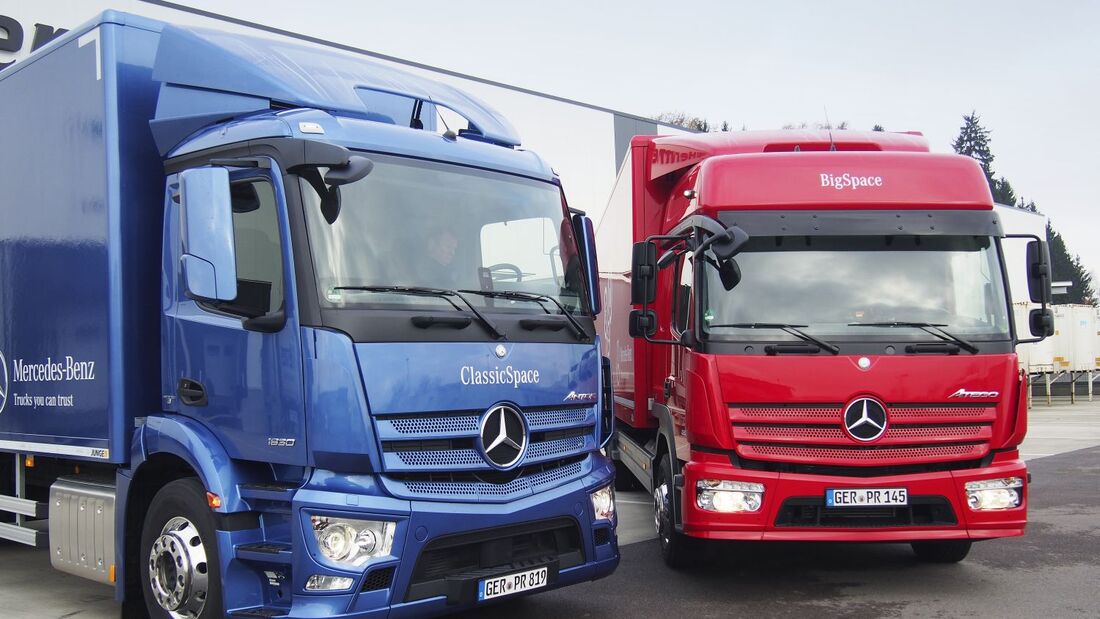
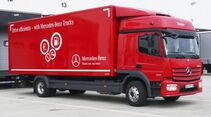
From a technical perspective, both vehicles have a lot in common, even though the unladen weight of the Atego 1530 is three tons lower than that of the Antos 1830. Both vehicles use the same 7.7-liter, six-cylinder OM 936 engine that generates 300 hp. They also share the automated eight-speed PowerShift 3 gearbox. The differences start in the driver's cab. The Atego uses the large Big Space driver's cab, while the Antos has to do with the more compact Classic Space. Both vehicles have a light box body with tail lift on the frame.
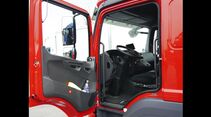
Round one in the battle of the Mercedes is all about first impressions – checking entry, workspace and rest area. The Atego does well here. The wide entry via two anti-slip steps, combined with the wide-opening door and a handrail stretching all the way to the bottom of the driver's cab make climbing in and out easy. This is an important advantage for urban distribution with frequent delivery stops.
190 centimeters of standing room
After climbing up the steps, the driver enters the "Big Space" driver's cab with its high roof. It boasts a huge 190 centimeters of standing room in front of the dashboard and around seven cubic meters of interior space, making the 15-ton truck a comfortable mid-weight cruiser. The smart-looking, cold-foam mattress fitted behind the seats makes the idea of sleeping in the Atego more appealing, and the storage compartments in the ceiling offer an astonishing amount of space. In distribution, the long driver's cab is of course a pure luxury that no fleet operator would approve. But the Atego driver's cab comes into it own once the vehicle hits the open road fitted with a trailer and loaded with light bulk freight.
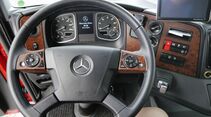
The driver's workspace in the Atego is equally impressive, and features the same cockpit as the full-fledged long-distance models. A clear graphic display in the center of the dashboard, combined with a standard-issue multi-functional steering wheel and the usual buttons ensure clarity and comfort behind the wheel. It reminds us more than slightly of the cockpit in the larger Actros. However, we did find that there are too many control stalks on the right side of the steering column. Both the engine brake and the automated PowerShift-3 gearbox fitted as standard in Germany are controlled from here. The wide array of functions does require some getting used to.
Alongside the widely adjustable driver's seat, the Atego's driver's cab has to accommodate a bulky engine tunnel. This largely prevents the driver from clambering over to the passenger seat, no matter what the sales brochure says.
Round one goes to the Atego
The larger Antos leaves a much more sober first impression. The Classic Space driver's cab is accessed via three steps. The Antos' driver's cab, which is both the shortest and lowest available, makes no secret of its pragmatic configuration. Despite this, the interior is still a comfortable place. The driver's seat can be adjusted all the way to the rear wall, making it suitable for tall drivers. The headroom is sufficient but no more.
Storage space for bags and other accessories is limited to the area behind the passenger seat. Alternatively, as in our test vehicle, you can order an extra storage box fitted on the wide engine tunnel. Although it takes up additional space, it can store everything you need and also serve as a desk for writing or eating. In such a compact driver's cab, however, it's difficult to expect more comfort accessories. In exchange, the workspace offers everything you'd expect from the new Mercedes truck models, such as a modern instrument displays and sensibly arranged switches. As in the Atego, the multi-functional steering wheel comes as standard, with the leather trim the only optional extra. Overall, however, round one goes to the Atego, whose comfort equipment represents the best money can buy, while the Antos tends towards thrifty austerity.
In the second round, however, it's not the buyer's willingness to open their wallet that counts. That's because it's time to put the two through their paces on our demanding test circuit, a mix of easy and difficult roads plus a stretch on the highway.
The chassis in the Atego is said to offer a comfortable ride. Even though the last model update saw the addition of a new rear-axle linkage, the light Mercedes has not completely lost all of its comfort-focused road holding, with noticeable frame torsion and a slight swaying tendency at the rear axle. The soft extension and compression of the all-round leaf-sprung chassis is not to everyone's taste. Thanks to the new four-point driver's cab suspension and perfectly responsive ZF steering, however, the Atego offers a precise driving experience, with the only minus points coming from the steering's weak restoring forces. The brake system features four disc brakes that go about their work effectively and sensitively. The braking power of the 300-kW engine brake is also sufficient to reliably stop trucks towing trailers.
Drivetrain stalemate
As an out and out open-road truck, the Antos is the far more uncompromising vehicle. You sit up high and enjoy the view. The mix of single-leaf suspension at the front and air suspension at the rear creates a good mix of firmness and driving comfort. The slightly more indirect steering ratio sticks neatly and accurately to the drive line. Here too, the brakes work flawlessly in conjunction with the upstream engine brake. And even if the Atego seems slightly more agile with its smaller 19.5-inch wheels, the three ton heavier Antos is the clear winner here. From the subjective driving impression too, it really belongs to a higher vehicle class.
Straight-six engine runs like silk
Turning to the prime discipline of the drivetrain, the fact that both vehicles share the same engine, horsepower and torque values, as well as the identical eight-speed gearbox, promises a stalemate. The lower axle ratio at the rear of the Antos elegantly compensates for the slight disadvantage in weight and rolling resistance. There are also no differences at the steering wheel, with the driving experience good in all aspects. The straight-six engine runs like silk. Its smooth power delivery in the main operating range certainly sets the benchmark for this vehicle class. Combined with the quick and smart-shifting eight-speed gearbox, this results in driving dynamics that virtually no other manufacturer in this class can offer. This is true of both the 15- and 18-ton models. At the end of this round, therefore, we have a stalemate.
Round four takes place at the distribution center, with the Antos and Atego reversing up to the loading ramp. Although the Atego is the more maneuverable of the pair, the lower seat position results in a slightly worse view of the rear than in the Antos. The leaf spring suspension on the rear axle of the Atego requires a height adjustment to the ramp using the tail lift. The air suspension on the Antos' rear axle does this better. The points go to the Antos.
One ton of payload for one liter of extra consumption
Round five takes place in the office of the fleet manager, whose red pen is already twitching. With an overall weight three tons lower than that of its rival, the Atego weighs two tons less than the Antos when unladen and fully fueled. This means it hands only a single ton of payload to its bigger brother. Under identical conditions, it consumes around one liter less of diesel per 100 kilometers. Both vehicles are capable of towing trailers up to a total weight of 32 tons. One ton of extra payload for one liter more in consumption – good deal or another deadlock? The difference becomes clearer when we compare the vehicles' purchase prices. Here, the 18-ton Antos is 14,560 euro pricier than its rival.
Does this mean defeat for the Antos? No! Thanks to its larger configuration, the Antos can carry greater load and tow a trailer. This towing ability makes the Antos perfect for supplying supermarkets in the surrounding area with a hitched central-axle trailer. Even though the Atego can also tow trailers, it feels much more home as an agile urban and cross-country delivery vehicle.
The only question remaining is that of the driver's cab. In our opinion, we'd prefer a shorter driver's cab on the Atego and a longer one on the Antos with a high roof. This would make it better suited to its actual role of distribution with occasional long-distance trips, as well as helping to keep peace in the family.