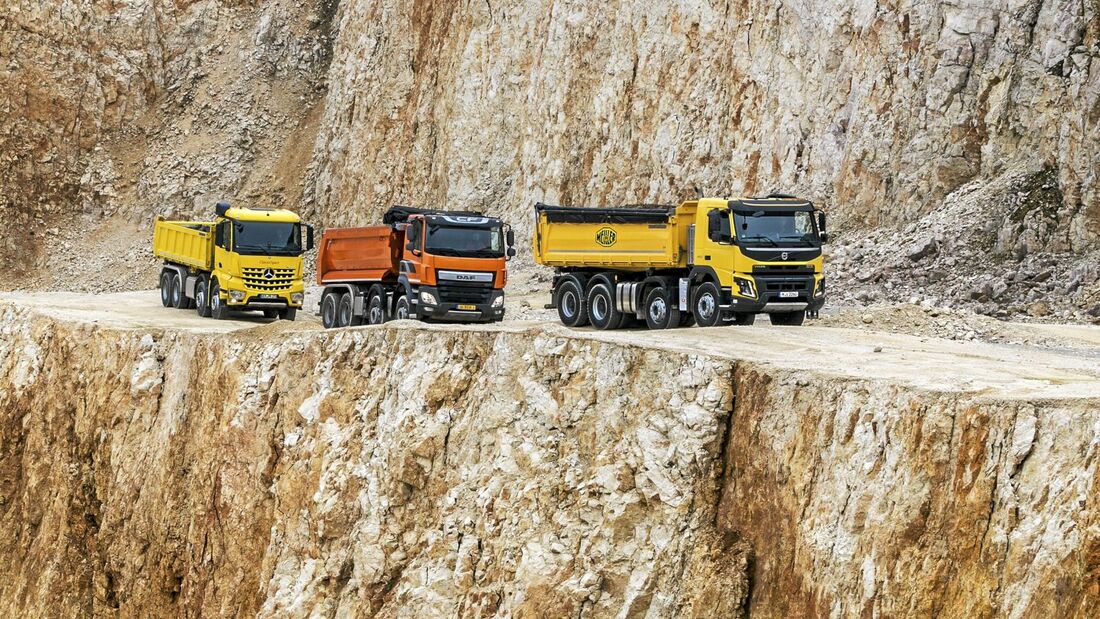
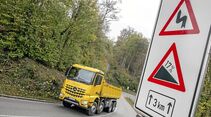
The Bissinger Steige in southwestern Germany is one of the toughest stretches of roadway for truck drivers. From the town of Bissingen at the foot of Teck Castle, it leads up towards the town of Ochsenwang on the heights of the Swabian Alps mountain range. Trucks on this route have to deal with an elevation difference of 400 meters, rising steeply at a 17-percent incline over a relatively short distance. That's a pretty tough job for a four-axle truck weighing 32 tons.
And it's on this stretch that we put the candidates to their first serious test, with the trucks driving up the barbaric incline in normal road mode and in off-road mode. The aim of the exercise is to find out how the off-road mode differs from the normal automatic mode among the three test vehicles.
The first result of this test is that the demanding route, with its mean hairpin at the very end, posed no significant problems for the trucks in either normal automatic mode or off-road mode. The second and more revealing result is how the vehicles' different characters become apparent in off-road mode.
The reduction of gear changes with off-road mode activated compared to the non-stop shifting in normal road mode, for example, varies between vehicles. The DAF, with its 12-speed AF-Tronic gearbox, shows the most radical difference. It performs only around half as many shifts on incline in off-road mode compared to normal mode. The Mercedes Arocs has more choice with 16 gears. In off-road mode, the number of shifts falls only by around a quarter. The Volvo FMX achieves a similar result with its 12-speed I-Shift gearbox, with gear shifts reduced by around a quarter.
Points go to the DAF and Mercedes on steep inclines.
Advantage DAF? Yes, to an extent. Keeping the number of gear shifts as low as possible in off-road mode is desirable, as the clutch finds frequent gear changes at high stress somewhat difficult to digest.
On the other hand, the Mercedes Arocs with its PowerShift gearbox also handles the incline well. A certain proportion of the shifts on this 17-percent incline are due to clearly noticeable efforts to avoid missing an opportunity. The off-road mode of the PowerShift thus prefers to shift quickly from sixth to seventh gear, because the vehicle can still handle the incline in this gear. The strategy in the Volvo is less clear. It seems to try different things, leaving a somewhat confusing picture.
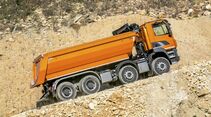
This admittedly does not tell us much about how it handles rough terrain. But our next testing ground is not far away, just 15 kilometers from Ochsenwang on the Alb plateau. Our test takes place in a massive quarry near the village of Zainingen that can be seen for miles around. Here, a good 100 meters up, the shimmering, yellowish-white limestone layers of the Swabian Alps are exposed on four so-called excavation beds. The slopes of these vertical beds, dynamited into the mountain, rise steeply to the crest.
Slope load test
These slopes are the perfect place to put the off-road modes of the three automatic gearboxes to the test under tough conditions. First things first, neither the AS-Tronic in the DAF, nor the Volvo's I-Shift or the PowerShift in the Mercedes embarrasses itself even under these conditions, as long as the driver proceeds cautiously. Small differences, at least in terms of the shifting strategy under extreme driving resistance, do become apparent when mistakes are provoked. This includes willfully causing an upshift at the start of an incline, which immediately requires the gearbox to shift down through a handful of gear stages.
Putting the individual test vehicles through such a procedure gave the following results. The Mercedes PowerShift's off-road mode gains a slight advantage, as it is not just a champion in terms of shifting speed. Precision when shifting down is astonishing every time. On the test slope, this means that it changes promptly from seventh gear down to third – the starting gear of choice under these conditions.
As on the Bissinger Steige, the AS-Tronic takes a more relaxed approach and is a touch slower than the Mercedes PowerShift in shifting both up and down. In the end, it performs the task almost just as well. Like the PowerShift, it simply shifts to the best starting gear for the situation, in the AS-Tronic's case the second.
The I-Shift in the Volvo, on the other hand, fails to achieve these levels of finesse when shifting down. Detecting the right gear step takes noticeably more time. It then overshoots when shifting down, moving to first gear even though second would suffice.
Turbo retarder clutch
There is also little to separate the three systems in terms of shifting comfort. The most pleasant is without doubt the DAF, which runs extremely quietly by performing the shift calmly and precisely. The Volvo is a little rougher in this regard, in that it tries to compensate for its somewhat longer thinking time in difficult situations. The PowerShift in the Mercedes, on the other hand, shifts so quickly that it's somewhat jagged. And as the OM 471 spares no punches in all this, the PowerShift does create the impression of being the most acoustically skittish of the three.
So it's time to take things a little slower. "Lower the revs and don't go too heavy on the clutch" – that's the motto when eying the systems' maneuvering capabilities. Once again, this is the Mercedes' time to shine. The Arocs too has now adopted the turbo retarder clutch that have long been fitted in heavy-duty tractors like the SLT. This clutch is available in the Arocs only as an option, and costs an extra 20,800 euro, as well as subtracting 150 kilograms from the payload.
It does provide two advantages, however. Maneuvering is wonderfully sensitive, regardless of how strongly driving resistance or downhill force of the vehicle work against it. The system also goes about its businesses completely free of wear, which is by no means the case in the friction clutches of the DAF or Volvo.
Moving centimeter by centimeter against the gear (such as by driving forwards downhill with reverse gear engaged) will in most friction clutches quickly result in a warning on the display that the clutch is overheating. If the driver ignores this warning, he will be reminded in a more pungent way. The wear-free turbo retarder clutch, on the other hand, lets you play around like this almost to your heart's content.
Ergonomic qualities in comparison
When creeping down steep slopes, the Voith system works not only as a hydrodynamic clutch, but also as primary retarder, making even the steepest slopes less intimidating. The reinforced engine brakes in both the DAF and the Volvo may be pretty gutsy, but the off-road driver will always find the turbo retarder clutch in the Arocs better and more comfortable.
The disadvantage of the turbo retarder clutch is that the maneuvering mode does not automatically engage as is normal in the PowerShift, but requires manual activation via a button. The maneuvering mode in the DAF is also controlled via a rotary switch in the instruments. There is a difference between the two, however. In the Mercedes PowerShift, a kickdown is all that's required to exit the maneuvering mode. In the DAF, by contrast, the switch has to be manually turned back to the starting position. Only the Volvo I-Shift offers a fully automatic maneuvering mode. It then wastes no time in switching back to drive mode when appropriate.
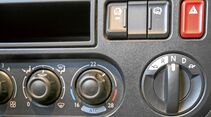
In terms of the controls, the contest of ergonomic qualities between the different systems is less tight than the way they handle tough terrain. This becomes apparent as soon as you engage the off-road mode. In the Arocs, you can keep your hand on the steering wheel and simply press the button on the control stalk. In the DAF, you have to flip a special switch, which rather than in the dial for the AS-Tronic, is located to the left. Activating off-road mode in the Volvo requires you to press a button marked "P+," located on the switch console to the right of the seat and therefore out of view. This abbreviation stands for "Performance+" and refers to the off-road mode, which is not immediately obvious. You then need a sharp eye to locate the tiny "P+" in the central display.
This always appears when off-road mode is activated. The feedback in the DAF is also somewhat scant. The Dutch manufacturers chose a cute little gearwheel silhouette as the symbol for off-road mode, surrounding an outlined dump truck. Once off-road mode is activated, the same symbol chooses to appear in the bottom-left corner of the tachometer instead of in the central display. This is not immediately obvious either.
The Mercedes Arocs is more straightforward and simply calls it what it is. "A offroad" appears unmistakably beneath the gear display as soon as the off-road mode is activated.
Opinions differ when it comes to which extra functions are a good idea for an off-road automatic gearbox. One thing that is agreed, however, is the need for a rock-free function. From a technical perspective, this is a clutch that opens and closes as quickly as possible. Otherwise the vehicle would be unable to break free from the mud. In the DAF's AS-Tronic, the electronics detect what is required from the corresponding movements of the gas pedal. The I-Shift in the Volvo also provides the rock-free mode automatically. We strongly recommend deactivating the TCS traction control system beforehand via the button, however. In the Mercedes PowerShift, you have to press an additional button for this. In practice, rocking essentially works just as well in all three systems.
Quick shifting
What's also clear is the need to engage the differential locks first. The Mercedes Arocs does this by means of a practical rotary switch, while the DAF sticks to its double toggle switch, which sometimes leaves room for error. Volvo meanwhile uses a simple toggle switch with two catches. As with the rotary switch in the Mercedes, this switch works on a "first longitudinal, then transverse" basis.
The I-Shift is perfect for those looking to switch between forward and reverse gears quickly, as it is the only gearbox to immediately implement the control input. In both the Mercedes PowerShift and DAF AS-Tronic, this change between forward and reverse gears takes a moment, which can quickly take the fun out of the whole thing.
Volvo does its own thing by offering additional options, such as a kind of power start system that is known in I-Shift as "Launch Control." With the lowest gear engaged, the minus button on the console pressed and the gas pedal to the floor, the tachometer rises to around 1,300 rpm. Upon releasing the minus button, the vehicle frees itself forwards, assuming the tires can provide the required grip and the wheels don't spin through. The Volvo I-Shift also enables a kind of creep mode, which allows it to move steadily at a set speed like the old RQV governor in the Unimog.
Whether such finesses are necessary, however, is another question. What's certain is that all three of the off-road systems tested here do their job impeccably, and have improved considerably. The Mercedes Arocs comes out on top by a slight margin, however, thanks to its especially sophisticated functionality, much more modern controls and, last but not least, the turbo retarder clutch. The DAF AS-Tronic and Volvo I-Shift also showed impressive capabilities, however. The two systems work extremely well at an identically high level.